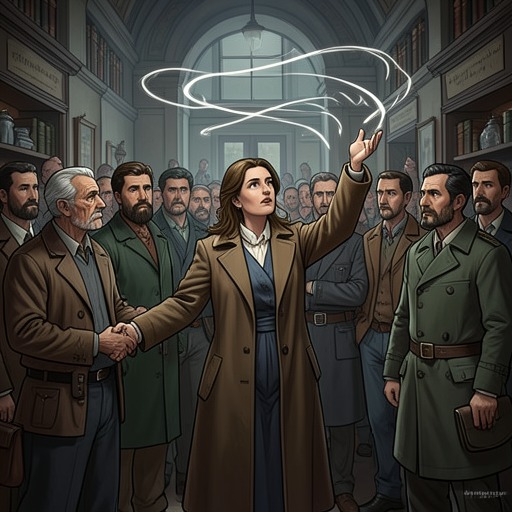
Lizzy is left behind at the Santa Fe convent
The StaircaseLizzy is left behind at the Santa Fe convent when her father secretly departs with the caravan, turning a nighttime discovery into an abrupt separation she can neither prevent nor accept. The episode makes abandonment concrete: the wagons are already being prepared under moonlight, the door will not open, and the father Lizzy calls for is gone before she can say goodbye.
Causes and Background
The departure first appears to Lizzy as a possibility she can explain away. Awakened by a long scream, she finds herself in a room whose furnishings seem out of place, then remembers that she is at the convent. From the window she sees people moving among the wagons, hitching up oxen and loading packs onto mules. The caravan is preparing to leave Santa Fe.
Lizzy initially imagines that arrangements were made after she fell asleep and that someone will soon wake her. She remembers Mother Magdalena’s warning that Santa Fe is different at night and that street screams need not frighten the convent’s residents. That explanation gives her a momentary way to treat the departure as an oversight rather than a decision. She hurries to dress because she believes her father may still expect her to join the caravan.
The scene’s anguish comes partly from the knowledge Lizzy has been resisting. When Mother Magdalena tells her the truth, Lizzy recognizes that she had sensed it for days, as though the realization had been cutting into her, but had refused to acknowledge it. The father’s decision was not made at the last moment: he has chosen to leave her with the convent, although the evidence does not disclose all the circumstances behind that choice. What makes the separation harsher for Lizzy is that he has not told her himself.
The Departure and Its Discovery
Lizzy tries to get out and demands to know where the key is. When the door will not budge, she accuses Elinora of lying and suspects that Elinora arranged things with her father to make her stay. She pounds on the door and calls for her father, insisting that she is coming and pleading for him to wait. Her effort is directed toward a departure already underway: outside, the caravan is being hitched and packed, while she remains shut inside.
At first Lizzy thinks the scream she hears comes from the street and might be preventing her father from hearing her. Then she realizes that the screaming has been her own. Mother Magdalena approaches and holds her, telling her to be quiet lest she wake the house. Lizzy asks her to go outside and tell her father she is coming, still treating the separation as something that might be interrupted if only the message reaches him.
Mother Magdalena answers that he has not forgotten Lizzy. He has decided to leave her with the convent, she says, and could not tell her himself because he thought this was best. The distinction between being forgotten and being deliberately left does not comfort Lizzy: it confirms that her father knew she would be alone and chose to go without facing her. Lizzy begs to accompany him to Colorado, saying that he needs her, but the decision is not reversed.
Confrontation and Immediate Aftermath
Lizzy asks at least to be let out so she can say goodbye, and asks why her father did not say goodbye himself. Mother Magdalena repeats that he could not. The caravan’s departure becomes unmistakable when the shouts used to direct the animals come from outside. Lizzy sobs and begs, explicitly contrasting this helplessness with the part of herself connected to Cheyenne and Blackfoot that never cries and with her belief that she never begged for anything.
As the caravan pulls away, Lizzy screams and struggles in Mother Magdalena’s arms. She eventually breaks free and strikes Elinora in the face, calling her a pious little buffalo chip and saying that she hates her. The blow redirects some of the scene’s force toward the person Lizzy suspects of helping to arrange the abandonment. Elinora is sobbing; nuns help her to bed. Before leaving, Elinora asks why Lizzy wants to follow a father who sneaks away without saying goodbye. Her challenge exposes the painful contradiction Lizzy cannot resolve: she longs to go with him even after his departure has shown her that he has chosen not to take her.
Lizzy collapses to the floor as the caravan’s final sounds pass outside—the jingling harnesses and creaking wagon wheels—then give way to silence. Another scream follows, but Lizzy knows from her sore throat that it comes from her, not from the street. The ending of the departure is therefore registered both in the emptying sound outside and in the bodily cost of her grief.
Consequences and Significance
The next morning does not soften the separation. Lizzy wants to remain in bed, but a nun wakes her for holy mass. Her throat hurts from screaming, her head from lack of sleep, and her heart aches from betrayal. She wonders how long everyone in the caravan had known her father intended to leave her, and concludes that Elinora must have known too. Her suspicion that Elinora may have persuaded him remains Lizzy’s angry conjecture, not a confirmed account of how the decision was made.
The episode changes Lizzy’s place in the story from a child expecting to travel with her father to someone left in the care of the convent. It also fixes the terms of that change through a stark mismatch between intention and experience: her father believes leaving her there is best, while Lizzy experiences the unannounced departure as abandonment and humiliation. Mother Magdalena’s embrace briefly recalls the comfort of being held since Mama died, but Lizzy struggles against it because she wants her father, not a substitute for him. The caravan’s departure closes off the immediate possibility of following him; the knowledge that others knew beforehand deepens the wound beyond the separation itself.